To continue my theme of trying to make up for lost blog time, I'm going to write one that I should have written on February 15th.
So Valentine's Day in Japan. Now, ordinarily my feelings towards contemporary Valentine's Day itself range from indifference to stupefied contempt. For years, I was preaching that this was a holiday who's purpose was to screw men over by an overstimulation of the economy and our women's joy meters - The whole day a superfluous attempt to convince us that there need be one specific day on which to show someone that we care lest we be put into the doghouse. Here, things are different.
On Valentine's Day in Japan, the tables are turned: It is in fact women who buy things for men. Usually it is something small, most often being chocolate. Also, it doesn't have to be confined to that special someone; women will sometimes give something small to a boss, coworker, or friend, just for the hell of it. Well, it's to foster improved relations vis-a-vis other people, I suppose. She's not compelled to give something to everyone male in the office, however; usually just a close friend or two will do.
Whatever the reason, I mind not. For on my day, I cashed in bigtime. It's not to say that my desk looked like a Laura Secord, but I did get a few little chocolates here and there from teachers, students, and even one mystery (Scandal @ school - who are you, mystery-chocolate-giver?!). Now, this gives rise to a puzzling internal dilemma. On the one hand, the slightly obligatory but nonetheless personally volitional nature of the chocolate causes me to side with my standing mindset on the issue, namely that it's a commercialized trap. However, the joy-joy feelings imbued from getting said chocolate tends to push those feelings aside. So brand me a hypocrite if you will, but I was quite happy with - for the first time - having the tables turned and being the one to reap benefits from yet another manifestation of the decline of Western Civilization (I wonder if this is how women feel on Valentine's day...).
One thing to note: This isn't the end of it. Oh no. In fact, in March, there's a day called White Day in which men are expected to repay those who gave them gifts on Valentine's. Three-fold, in fact. And THIS day was completely created out of the blue, purely for the expressed purpose of generating revenue. Nevertheless, most ladies who were generous a month prior find themselves in a Valentine's Day stupor when they're surprised with even better chocolate than what they gave.
So for men here, I guess there really is no such thing as a free lunch.
Thursday, March 13, 2008

Tuesday, March 4, 2008
Kanpai!
Laments and apologies to all. I know that I have taken quite the hiatus amidst promises of updating regularly, and have received a number of complaints re the quality and quantity of the blog. Therefore, I'm coming back to it full steam with a few new posts delivered at rapid-fire pace. The next few will go in descending chronological order however, so raise too many eyebrows at seeing a post for Valentine's day in the middle of March. I'll start with a topic that's fresh in me mind as I experienced it just 12 hours ago.
Japanese cultural lesson for today: Enkai - 宴会
This roughly translates as a banquet, but it boils down to being a work party. You know how sometimes you and a few friends get together after for a drink or two to unwind? Well, an enkai is basically the same thing except that you more or less have to go. And the few friends is all the teachers in the faculty/grade/school. And a drink or two is several or more. That's enkai in a very small nutshell.
There are more serious and formal enkai that follow the important events at school, such as start/end of the school year ceremonies, graduation, end of the term, end of the year, and so on. Rule of thumb is that if there's a ceremony of sorts at school, or a long vacation is about to start, then there's going to be an enkai that night. These usually include the entire school, including the principal, vice-principals, all teachers, office and grounds staff, and sometimes even PTA representatives or members of the school board. Beyond that, there are any number of smaller enkai that can be held for any number of reasons by any number of people. If the third year teachers prep for a month for a demonstration class for the school board and it's now over, enkai. If the science teachers finish a very large and important unit that required them to work more than usual, enkai. All the first year teachers want to get together right after the new year to have a mini pep rally, enkai. So on and so forth. These can range in size, but anything smaller than maybe five or six might just be considered dinner. Also, attendance isn't mandatory at any of them. However most everyone goes. They're more often than not quite fun, and it's a good way to foster good relationships with your fellow teachers.
Enkai begins with sitting in your assigned seat, or drawing a table or seat number from a hat. The principal or next highest up will make a short speech to commemorate whatever it is we may be celebrating and then a toast follows, "Kanpai!" We are then fed... everything. Plate after plate after plate of the most interesting foods you'll ever see. Mostly fish. It looks like each plate was storyboarded by Da Vinci, cooked by Wolfgang Puck, and sculpted on the plate by Michelangelo. In this manner, maybe five or six (or more) plates will meet you over the course of the evening, though only perhaps three or four will be fully devoured (I'll explain why in a minute).
And after that first cheers, that's when the drinking starts... These enkai are nearly always all you can drink, in that we don't have to order - the bottles are just brought out as fast as we can drink them. Therefore there's no need to baby a drink for a long time, or worry about the next round costing an arm and a leg. I've got to explain something about Japanese drinking. The glass is never half empty or half full here because it's always full. Customs here is that when you're out not by yourself, you pour the other person's drink. So if I notice that my friend beside me's cup is getting empty, I have to jump and top it off lest I be seen as rude. If someone fills their own drink the whole table we all @ the table realize it and collectively sigh in realizing that we've failed another of life's little tests. So after every bite it seems, you take a notice of everyone's class, and if even a sip is missing (a pseudo-exaggeration), or even if it's someone across the table, you get up, walk around there and pour in the 5 millilitres that are missing.
Eating and drinking continue for a while until people decide to take a bottle in hand and go visit other teachers to shoot the breeze. During said shooting, everyone seems to stop eating amidst the delicacies surreptitiously placed in front of us as the night goes on. Topping and polishing off bottles at Olympic marathon speeds, things quickly move from being a quiet dinner to raucously loud and open conversations about nearly everything under the sun. This gets louder and bawdier until about two hours have passed when, on the stroke of the minute, everyone promptly gets up and departs. But oh no, the fun doesn't end here. More often than not, a second (or several distinct second) brew ha ha will informally convene with a smaller group of friends at a nearby establishment to basically keep the party going. Third parties are rare, but do happen amongst the saucier teachers.
That is the short and skinny of what an enkai is. It ends not here, though, for what blog update would be complete without demonstrating how this vainly relates to me own life. Especially since I attended an enkai last night and thus can offer first-hand application details.
After the bottles really start to be popped with alacrity, we move to the stage that I like to call "Partytime" but like to think of in my head as "Let's Practice English Time". It's around here that I discovered that - lo and behold - quite a number of my teachers can not only understand but can quite skillfully speak English. Someone will sit down beside me with a bottle in hand to top me off, and then bust out a, "So? You enjoy beer? So do I. What kind of things do you drink in Canada?". As my eyes retreat back into my head, my response will then foster a rather coherent and lengthy conversation about everything under the sun, invariably looking and Canada and/or Japan in some way. The interesting thing about "Partytime" is that teachers whom I never speak to, or who will rarely even acknowledge that I come to their school will all of a sudden find the (liquid) courage to not only approach me for a conversation, but will also do so in English. Going beyond that now, their English is frequently much more better than my feeble Japanese. In theory, I could pass a whole day @ school with hearing 50/50 Japanese/English if everyone all of a sudden developed a "We Love English" attitude.
The only downtime to "Partytime" is that being the ALT seems to act as a bullseye for teachers with bottle in hand. You're targeted and prompty approached for a topoff, which you CAN refuse in theory, but seldom do in practice as to be polite. And a topoff itself isn't so much a detriment to one's state of being, but several rapid topoffs, by several people, over several minutes, over the course of the party will rapidly accumulate to several pints being consumed with realtive easy. And this is before even mentionning sake or several other Japanese alcohols (If you're discovered to be able to drink Japanese alcohol, you may as well just take an instant-hangover pill and go home right then and there).
"Partytime" also rocks because it affords a glimpse into a seldom-viewed world. You'll often see some certain coworkers @ their desks Mon-Fri 9-5 (More like 8-7) doing nothing but work, often not saying more than a few words, and being in all ways unassuming. And by the end of an enkai, those same busybees are talking ears off and becoming the life of the party. And odder still is seeing them back to their quiet, hardworking ways the very next morning as though nothing happened. It's refreshing to know that there is life beyond the office. Which brings me to the next point: The next day at work, we all act as though nothing happened. No matter how crazy or awesome or scary things get, no matter what is said or done, who's insulted or startled or amazed, it's out of sight and mind by 8 AM. Truly, what happens at enkai stays at enkai.
So that's a work party in a nutshell. We hope that you've enjoyed this cultural lesson. We do hope that you'll give this a try yourself as on any given night in Japan, somewhere, someone is having an enkai. Well, there are probably any number of thousands each night across the country, so find one today and crush a cup of sake!
Japanese cultural lesson for today: Enkai - 宴会
This roughly translates as a banquet, but it boils down to being a work party. You know how sometimes you and a few friends get together after for a drink or two to unwind? Well, an enkai is basically the same thing except that you more or less have to go. And the few friends is all the teachers in the faculty/grade/school. And a drink or two is several or more. That's enkai in a very small nutshell.
There are more serious and formal enkai that follow the important events at school, such as start/end of the school year ceremonies, graduation, end of the term, end of the year, and so on. Rule of thumb is that if there's a ceremony of sorts at school, or a long vacation is about to start, then there's going to be an enkai that night. These usually include the entire school, including the principal, vice-principals, all teachers, office and grounds staff, and sometimes even PTA representatives or members of the school board. Beyond that, there are any number of smaller enkai that can be held for any number of reasons by any number of people. If the third year teachers prep for a month for a demonstration class for the school board and it's now over, enkai. If the science teachers finish a very large and important unit that required them to work more than usual, enkai. All the first year teachers want to get together right after the new year to have a mini pep rally, enkai. So on and so forth. These can range in size, but anything smaller than maybe five or six might just be considered dinner. Also, attendance isn't mandatory at any of them. However most everyone goes. They're more often than not quite fun, and it's a good way to foster good relationships with your fellow teachers.
Enkai begins with sitting in your assigned seat, or drawing a table or seat number from a hat. The principal or next highest up will make a short speech to commemorate whatever it is we may be celebrating and then a toast follows, "Kanpai!" We are then fed... everything. Plate after plate after plate of the most interesting foods you'll ever see. Mostly fish. It looks like each plate was storyboarded by Da Vinci, cooked by Wolfgang Puck, and sculpted on the plate by Michelangelo. In this manner, maybe five or six (or more) plates will meet you over the course of the evening, though only perhaps three or four will be fully devoured (I'll explain why in a minute).
And after that first cheers, that's when the drinking starts... These enkai are nearly always all you can drink, in that we don't have to order - the bottles are just brought out as fast as we can drink them. Therefore there's no need to baby a drink for a long time, or worry about the next round costing an arm and a leg. I've got to explain something about Japanese drinking. The glass is never half empty or half full here because it's always full. Customs here is that when you're out not by yourself, you pour the other person's drink. So if I notice that my friend beside me's cup is getting empty, I have to jump and top it off lest I be seen as rude. If someone fills their own drink the whole table we all @ the table realize it and collectively sigh in realizing that we've failed another of life's little tests. So after every bite it seems, you take a notice of everyone's class, and if even a sip is missing (a pseudo-exaggeration), or even if it's someone across the table, you get up, walk around there and pour in the 5 millilitres that are missing.
Eating and drinking continue for a while until people decide to take a bottle in hand and go visit other teachers to shoot the breeze. During said shooting, everyone seems to stop eating amidst the delicacies surreptitiously placed in front of us as the night goes on. Topping and polishing off bottles at Olympic marathon speeds, things quickly move from being a quiet dinner to raucously loud and open conversations about nearly everything under the sun. This gets louder and bawdier until about two hours have passed when, on the stroke of the minute, everyone promptly gets up and departs. But oh no, the fun doesn't end here. More often than not, a second (or several distinct second) brew ha ha will informally convene with a smaller group of friends at a nearby establishment to basically keep the party going. Third parties are rare, but do happen amongst the saucier teachers.
That is the short and skinny of what an enkai is. It ends not here, though, for what blog update would be complete without demonstrating how this vainly relates to me own life. Especially since I attended an enkai last night and thus can offer first-hand application details.
After the bottles really start to be popped with alacrity, we move to the stage that I like to call "Partytime" but like to think of in my head as "Let's Practice English Time". It's around here that I discovered that - lo and behold - quite a number of my teachers can not only understand but can quite skillfully speak English. Someone will sit down beside me with a bottle in hand to top me off, and then bust out a, "So? You enjoy beer? So do I. What kind of things do you drink in Canada?". As my eyes retreat back into my head, my response will then foster a rather coherent and lengthy conversation about everything under the sun, invariably looking and Canada and/or Japan in some way. The interesting thing about "Partytime" is that teachers whom I never speak to, or who will rarely even acknowledge that I come to their school will all of a sudden find the (liquid) courage to not only approach me for a conversation, but will also do so in English. Going beyond that now, their English is frequently much more better than my feeble Japanese. In theory, I could pass a whole day @ school with hearing 50/50 Japanese/English if everyone all of a sudden developed a "We Love English" attitude.
The only downtime to "Partytime" is that being the ALT seems to act as a bullseye for teachers with bottle in hand. You're targeted and prompty approached for a topoff, which you CAN refuse in theory, but seldom do in practice as to be polite. And a topoff itself isn't so much a detriment to one's state of being, but several rapid topoffs, by several people, over several minutes, over the course of the party will rapidly accumulate to several pints being consumed with realtive easy. And this is before even mentionning sake or several other Japanese alcohols (If you're discovered to be able to drink Japanese alcohol, you may as well just take an instant-hangover pill and go home right then and there).
"Partytime" also rocks because it affords a glimpse into a seldom-viewed world. You'll often see some certain coworkers @ their desks Mon-Fri 9-5 (More like 8-7) doing nothing but work, often not saying more than a few words, and being in all ways unassuming. And by the end of an enkai, those same busybees are talking ears off and becoming the life of the party. And odder still is seeing them back to their quiet, hardworking ways the very next morning as though nothing happened. It's refreshing to know that there is life beyond the office. Which brings me to the next point: The next day at work, we all act as though nothing happened. No matter how crazy or awesome or scary things get, no matter what is said or done, who's insulted or startled or amazed, it's out of sight and mind by 8 AM. Truly, what happens at enkai stays at enkai.
So that's a work party in a nutshell. We hope that you've enjoyed this cultural lesson. We do hope that you'll give this a try yourself as on any given night in Japan, somewhere, someone is having an enkai. Well, there are probably any number of thousands each night across the country, so find one today and crush a cup of sake!
Thursday, January 17, 2008
Welcome 2008, あけおめ
What do bad Japanese, The Matrix, and Michael Jackson have in common? My trip to Tokyo
I had NO definitive clue as to what I'd be doing for the winter break for months – there had been plans made, canceled, remade all across the board, but none seemed solid enough to convince me. Talking with my friend Nicole from high school, who was in country teaching at an English conversation company, I learned that she had no plans either. Coupled with the fact that she'd been here almost four months and I hadn't seen her yet, I thought it a good move to go and catch up, and at the same time take in some of
But the approach would not be easy. Getting there would be akin to the journey from
Arrival in
Bright-eyed and bushy tailed, my guide and I embarked to take on

We then moseyed our way on over to Harajuku where sure enough there were people out in all sorts of anime/goth/just plain insane costumes to delight the tourists and get pictures taken. Truth be told, I've never fully understood it meself, but it didn't stop me from getting a few pictures taken with them. Navigating the endless and narrow streets gave witness to some of the most interesting and bizarre fashions I ever have seen. How on Earth some people walk buy and think, "That'd look good!" simply defies me. That being said, the businesses sure seemed to be thriving.

Later that evening, after passing the maddeningly expensive boutiques of Estee Lauder, Yves St. Laurent, and others, we found my friends @ the Gap, but declined an offer for dinner as we’d just eaten. Being far too tired to paint the town red that night, we visited the apartment of a few friend's of Nicole's and vegged to Japanese TV.
The next day following a wonderful sleep in, Nicole took me to Asakusa, which was host to

The best part of this though was Nicole's foray into Japanese. I can't remember how it came up, but I had told her that during my solo trip to Himeji that I was forced to teach myself how to ask someone to take a picture of me in Japanese (Which I'm quite proud to say I thought of correctly all by myself). She wanted to know what it was so I taught her, sufficient that she had it memorized. Not content to let it just slip away, I told her that we must test it out to make sure that she had it committed to memory. Thus, to the first "Japanese" people that we saw approach us – a young couple – she walked up and said, "Sumimasen. Shashin o tottemo ii desu ka?" (Excuse me, can you please take a picture?), done with hardly a mistake. The young man smiled and replied – In flawless English – "Sure, no problem." Not only did he speak English, but it sounded native, with no accent or hesitation @ all. If I didn't know any better, I'd swear that he was either a tourist visiting
 Oh, also, another thing to mention. Many people ask me how expensive it really is in
Shopping and donuts later, we returned home to

The countdown occurred on a randomly passing bus. We screamed. We hugged. We kissed. Such was the entrance into 2008. Next, after many deliberations and varied delays, we made it to a club around 1 to dance the year away. We somehow bartered the doorwoman to let us in for only $15 when the cover that night was $40, and I somehow kept drinking for free by recycling the one drink ticket that I had. Won't bore you with the details, but it was a fun, albeit tiring night. Audrey, her boyfriend, and I left after 4; while Nicole and a bunch of Australians hung around until 7 or 8 (The clubs don't really close here. You can dance all night if you want). Hats off to the subways being open all day that night. I think it was close to 6 when I finally passed out, a pile of exhaustion and exuberance.

On the train ride back, it stopped in Shimbashi, which I'd studied about in textbooks, and I thought, "I'm not rushing anywhere. I have the time. Why not?" So I get out and walk around. I think that a few hundred years ago it was a pleasure quarter of sorts. Now, it's a major business center.

Next day! We hit up
We only had time for a few places as I had to be back to catch my train, so we saw the Daibutsu (Literally, Big Buddha) and another temple whose name escapes me. Crowded, crowded, crowded as everyone was at the temples to pray for the new year. We couldn't join as the wait was something like two hours, so instead we just ate from various vendors around the temple and became fat from so many Japanese foods.


Thus, at this point, I had to bid farewell to me friends and hightail it back to
Weirdest thing about the trip was that towards the end, I was actually looking forward to coming back to Tottori. Big city living and all that as it was, I thought it all a little too... busy? Hectic? Fast-paced? I'm not sure how to coin it. But whatever it was, it had me longing for the relaxing air of the country. Or it could just be that in
Thursday, December 20, 2007
Beauty in Every Fallen Leaf
This one may take top prize as the latest entry thus far: three weeks. I don't know where to begin to describe the sheer volume of time-consuming activities that render our lives here busy beyond belief - and thus I won't endeavor to. I'll just say that "I've been a little engaged," and leave it at that.
So! Last (3) weekend(s ago), decided to crack one of the biggest eggs that Japan has to offer: The 1000+ year old city that is Kyoto - seat of emperors and cultural hub of the whole shebang. It's probably the one city that I've wanted to visit for as long as I've known about Japan. It's always held a piquing interest to know of the history that walks the very streets; that many a person since very long before I was born walked the same ones - It's fascinating.
First stop was Kinkakuji. This temple dates back some 800 years or so, however the actual building that we see is less than 100 years old itself. Nonetheless, it doesn't take away from the marvel of what it once was. And the nice thing about the compound is the surroundings of nature. The whole area is this sea of red and gold and green that frankly makes Canadian fall seem like just another season.


 The afternoon continued on with a destinationless wandering around the backstrees and alleyways of the city. One really gets that "lost in time" feel when they're going down streets that have changes very little over the course of centuries.


 The following noteworthy stop was Kiyomizu-dera, a Buddhist temple with over 1,000 years of history, and whose buildings date back almost 400 years. Truth be told, didn't take advantage AS MUCH of the cultural aspects of the temple, but, as it seems everyone else there was about, taking in the views from the temple was what it seemed to be about. Looking out over the forests and parks to see Kyoto in the background surrounded by mountains with the sunset approaching... No words of mine nor pictures that I could have taken could do it justice. It is such a sight that there is no ifs, ands, or buts about me returning to do it all over again. Simply incredible. When the ancient Japanese were designing a city, they certainly had their game faces on.


 All and all, the trip was short, but sweet - Lasting only that day. It can be said with certainty that I will be heading back there will all due speed, hopefully in the spring when the cherry blossoms come in. This city did not fall short in any capacity and as captivated me to seek more. Although it goes without saying that if one ever visits Japan that they must visit this city, I can now put my official endorsement behind it with all urgings that descriptions are understatements and it must be seen to be known.

So! Last (3) weekend(s ago), decided to crack one of the biggest eggs that Japan has to offer: The 1000+ year old city that is Kyoto - seat of emperors and cultural hub of the whole shebang. It's probably the one city that I've wanted to visit for as long as I've known about Japan. It's always held a piquing interest to know of the history that walks the very streets; that many a person since very long before I was born walked the same ones - It's fascinating.
First stop was Kinkakuji. This temple dates back some 800 years or so, however the actual building that we see is less than 100 years old itself. Nonetheless, it doesn't take away from the marvel of what it once was. And the nice thing about the compound is the surroundings of nature. The whole area is this sea of red and gold and green that frankly makes Canadian fall seem like just another season.
 The afternoon continued on with a destinationless wandering around the backstrees and alleyways of the city. One really gets that "lost in time" feel when they're going down streets that have changes very little over the course of centuries. The following noteworthy stop was Kiyomizu-dera, a Buddhist temple with over 1,000 years of history, and whose buildings date back almost 400 years. Truth be told, didn't take advantage AS MUCH of the cultural aspects of the temple, but, as it seems everyone else there was about, taking in the views from the temple was what it seemed to be about. Looking out over the forests and parks to see Kyoto in the background surrounded by mountains with the sunset approaching... No words of mine nor pictures that I could have taken could do it justice. It is such a sight that there is no ifs, ands, or buts about me returning to do it all over again. Simply incredible. When the ancient Japanese were designing a city, they certainly had their game faces on. All and all, the trip was short, but sweet - Lasting only that day. It can be said with certainty that I will be heading back there will all due speed, hopefully in the spring when the cherry blossoms come in. This city did not fall short in any capacity and as captivated me to seek more. Although it goes without saying that if one ever visits Japan that they must visit this city, I can now put my official endorsement behind it with all urgings that descriptions are understatements and it must be seen to be known.
Tuesday, December 18, 2007
"Do you agree with the idea that housework is for women?": A Student's Perspective
In my second year writing class, the students are doing a unit on housework with overtones of gender roles. They had a short assignment in which they had to evaluate the question, "Do you agree with the idea that housework is for women?", and respond with their own opinion. The following is one student's response that caused me to laugh for quite the while because I was picturing his situation in my mind. The spelling has been corrected for sake of legibility, but the grammar and word order are exactly as they appear on his paper.
I disagree with the idea. Because now, many Japanese women is working. My father very tired when finish father's works. But, my mother too. My mother and my father many mouth battle. But, they start the home work as soon as finish mouth battle. For example, my mother is wash the dish and clears the table. My father is smoking and eat a ice cream. My mother say "Hey you! You wash the your sox for yourself!" My father say "Yes, yes."
I disagree with the idea. Because now, many Japanese women is working. My father very tired when finish father's works. But, my mother too. My mother and my father many mouth battle. But, they start the home work as soon as finish mouth battle. For example, my mother is wash the dish and clears the table. My father is smoking and eat a ice cream. My mother say "Hey you! You wash the your sox for yourself!" My father say "Yes, yes."
Monday, December 17, 2007
Mochi, Mochi, Mochi, I made you out of rice...
I've recently discovered a new form of therapy designed to relieve stress and keep you in shape all at the same time. It runs along the same lines as punching bags and stress balls: Make mochi.
 One of my JTE (Japanese Teacher of English) from one school invited me to make mochi with her and her family (Including her twin brother, who happens to be a JTE at my other school) last Saturday.
For those of you not familiar with what mochi is: It's a rice cake made from really sticky rice. You pound it into a paste, as indicated here, then break it into smaller pieces and mold it. You can get it anytime, but it's usually a New Year's food. http://en.wikipedia.org/wiki/Mochi
You cook rice in a thicker-and-stickier-than-usual manner to get the right consistency, then you toss it all into an usu (type of big mortar) and mash it all together with kine (pestle - think high school science, but about 20x as big. And with handles. Once it's sufficiently mashed, that's when the therapy/fitness aspect kicks in. You have two people working on it: one to bash and the other to fix. The one bashing uses the kine in overhand strikes to beat the rice into paste; the one fixing keeps their hand wet with water and smacks the rice. This is done both to keep the rice from drying out, and also to indicate where to hit next. When the basher is breaking through all the way to the bottom, the fixer has to grab and end and fold it over to ensure that there's always a thick layer of rice to pound. Crazy thing is that this is done in between the strikes, so the fixer has about a half second in which to either smack the rice or grab and end and fold it over. Rhythm is key because it is very easy for the basher to bash fixer's hand, which no one wants to see happen.

 Once the rice is no longer rice and instead becomes sort of a white, homogeneous paste, it is placed on a wooden board with flour and separated into smaller pieces. These are then worked out by hand into disc-shaped portions that are left to cool. Once that's done, eat! It's a traditional New Year's food here
(Mid-sentence aside: New Year's here is where it's at. Christmas isn't really celebrated other than to give gifts, that being because more than 90% of the country is Shinto/Buddhist. But! New Year's is the spiritual time to let go of the current year and hope for good luck in the coming year. Very family-intensive. I make it that Japan's New Year is analogous to the West's Christmas in terms of family-time and sentimental meaning.)
and so it's often bought or given out as gifts. It's also used in the home as offerings at shrines, and and charms meant to bring good fortune.


 That all being said, it's quite relaxing to picture someone's face in the rice while you're beating it to high heaven. Not only does it turn it into paste faster, but it feels oh so good. I think that gyms should start stocking striking apparatuses - they work wonders for both the body and mind.
One bale of rice is more than enough to tire one out. So you can imagine my resignation when I learned that we were making six. Our rapid swings and devastating blows expended on the first bale soon gave way to haphazard hacks and snail-paced rhythms towards the end, and the time that we needed for break in between increased arithmetically.
After many a tired and grueling hour later, we all enjoyed lunch together, at which it seemed that my glass of beer could never be filled fast enough after the smallest sip. My JTE and his infant daughter had the right idea with a nap, and it goes without saying that as soon as I got home, I followed suit.
I'll be spending the next 11 months, 30 days training for next year's mochi-making day. I'll need every day, believe you me.
 One of my JTE (Japanese Teacher of English) from one school invited me to make mochi with her and her family (Including her twin brother, who happens to be a JTE at my other school) last Saturday.
For those of you not familiar with what mochi is: It's a rice cake made from really sticky rice. You pound it into a paste, as indicated here, then break it into smaller pieces and mold it. You can get it anytime, but it's usually a New Year's food. http://en.wikipedia.org/wiki/Mochi
You cook rice in a thicker-and-stickier-than-usual manner to get the right consistency, then you toss it all into an usu (type of big mortar) and mash it all together with kine (pestle - think high school science, but about 20x as big. And with handles. Once it's sufficiently mashed, that's when the therapy/fitness aspect kicks in. You have two people working on it: one to bash and the other to fix. The one bashing uses the kine in overhand strikes to beat the rice into paste; the one fixing keeps their hand wet with water and smacks the rice. This is done both to keep the rice from drying out, and also to indicate where to hit next. When the basher is breaking through all the way to the bottom, the fixer has to grab and end and fold it over to ensure that there's always a thick layer of rice to pound. Crazy thing is that this is done in between the strikes, so the fixer has about a half second in which to either smack the rice or grab and end and fold it over. Rhythm is key because it is very easy for the basher to bash fixer's hand, which no one wants to see happen.

 Once the rice is no longer rice and instead becomes sort of a white, homogeneous paste, it is placed on a wooden board with flour and separated into smaller pieces. These are then worked out by hand into disc-shaped portions that are left to cool. Once that's done, eat! It's a traditional New Year's food here
(Mid-sentence aside: New Year's here is where it's at. Christmas isn't really celebrated other than to give gifts, that being because more than 90% of the country is Shinto/Buddhist. But! New Year's is the spiritual time to let go of the current year and hope for good luck in the coming year. Very family-intensive. I make it that Japan's New Year is analogous to the West's Christmas in terms of family-time and sentimental meaning.)
and so it's often bought or given out as gifts. It's also used in the home as offerings at shrines, and and charms meant to bring good fortune.


 That all being said, it's quite relaxing to picture someone's face in the rice while you're beating it to high heaven. Not only does it turn it into paste faster, but it feels oh so good. I think that gyms should start stocking striking apparatuses - they work wonders for both the body and mind.
One bale of rice is more than enough to tire one out. So you can imagine my resignation when I learned that we were making six. Our rapid swings and devastating blows expended on the first bale soon gave way to haphazard hacks and snail-paced rhythms towards the end, and the time that we needed for break in between increased arithmetically.
After many a tired and grueling hour later, we all enjoyed lunch together, at which it seemed that my glass of beer could never be filled fast enough after the smallest sip. My JTE and his infant daughter had the right idea with a nap, and it goes without saying that as soon as I got home, I followed suit.
I'll be spending the next 11 months, 30 days training for next year's mochi-making day. I'll need every day, believe you me.
Thursday, December 13, 2007
Delicious Multiculturalism Goes International (Or, They call me Mr. Tibbs!... er, Mr. Levy)
As the law of averages will oft tell us in life, everything tends to have a way to even out. We hear it all the time: "Can't have the good without the bad", "Can't enjoy victory without knowing defeat", etc. Yesterday, I had one of those high days - the ones you get out of bed for and make work worth going to (At least, so much as one would want to go to work as opposed to spending all day in bed).
Day begins with the discovery that my afternoon classes are cancelled. For whatever reason, my one school has cancelled afternoon classes from now until the end of the semester. So the kids can go home at lunch. This nets me with just one class. Huzzah. Spend the first period making eggnog with one or two of my teachers for the first time. I never knew how easy it was to make. I highly recommend for those who have ready access to milk and eggs. After the time warp that accelerated me past my class, enjoyed lunch, and then prepped for my afternoon.
Today, we made Nanaimo Bars.
I'll have to explain why. So, maybe a month ago, the librarian approached me and asked of I could prepare a Canadian dessert for some students in December. I can't remember what the reason was - perhaps it was just an internationalization thing wherein I do something Canadian and talk with the kdis about it. I replied that I would and at once set to think of a sweet that screams "Canada". All I can say is amen to Wikipedia, because within five minutes of searching, I discovered the joy that is Nanaimo Bar. I've been slowly learning how to make it over the last month - even testing it out on friends during Thanksgiving Dinner. And yesterday was show time.


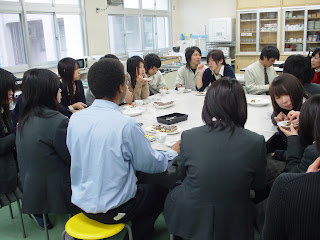 So for a week or so, there were ads around school saying, "Let's cook with Raymond-sensei!" I was expecting perhaps a half dozen students to show up; imagine my surprise when a good 20+ kids were in the room waiting for me, in addition to about six or so teachers. In a short and skinny, they made it all while I - the quote-unquote expert - supervised. They did a great job, and all turned out well. Afterwords, we ate and drank tea. The aforementioned eggnog was a surprise for them, as I didn't tell them that I'd be making it. All and all, it was a fun experience for me, but the best came at the very end.
Most of the students reluctantly tried the eggnog, reluctantly especially so after I told them that it was made from eggs. Some flat out refused. I got a few smiles from it and a few interesting expressions, but all and all they just seemed to quietly enjoy it. When we were all done and cleaned up, and the students had left, the teachers and I were talking when another student entered the room. She was a quiet girl who also attended my Jack O'Lantern demonstration a few months back. She apologized that she was unable to attend due to some unavoidable circumstance. The teachers gave her a piece of Nanaimo, and I also offered her a cup of eggnog to try. She took one sip, then looked up with widened eyes and exclaimed in a quiet voice, "Oishi!" (Delicious), after which she quickly finished the rest in a few quick gulps. Most of the other students just took it down without too much expression, so perhaps her genuine reaction stood out in my mind. I don't know why I thought that that was meaningful, but it really made my day when she thanked me for the delicious "Canadian" drink.

 They've asked me to do this sort of thing again in the spring, but this time make a Canadian food typically found at lunch/dinner. Any ideas?
Day begins with the discovery that my afternoon classes are cancelled. For whatever reason, my one school has cancelled afternoon classes from now until the end of the semester. So the kids can go home at lunch. This nets me with just one class. Huzzah. Spend the first period making eggnog with one or two of my teachers for the first time. I never knew how easy it was to make. I highly recommend for those who have ready access to milk and eggs. After the time warp that accelerated me past my class, enjoyed lunch, and then prepped for my afternoon.
Today, we made Nanaimo Bars.
I'll have to explain why. So, maybe a month ago, the librarian approached me and asked of I could prepare a Canadian dessert for some students in December. I can't remember what the reason was - perhaps it was just an internationalization thing wherein I do something Canadian and talk with the kdis about it. I replied that I would and at once set to think of a sweet that screams "Canada". All I can say is amen to Wikipedia, because within five minutes of searching, I discovered the joy that is Nanaimo Bar. I've been slowly learning how to make it over the last month - even testing it out on friends during Thanksgiving Dinner. And yesterday was show time.


 So for a week or so, there were ads around school saying, "Let's cook with Raymond-sensei!" I was expecting perhaps a half dozen students to show up; imagine my surprise when a good 20+ kids were in the room waiting for me, in addition to about six or so teachers. In a short and skinny, they made it all while I - the quote-unquote expert - supervised. They did a great job, and all turned out well. Afterwords, we ate and drank tea. The aforementioned eggnog was a surprise for them, as I didn't tell them that I'd be making it. All and all, it was a fun experience for me, but the best came at the very end.
Most of the students reluctantly tried the eggnog, reluctantly especially so after I told them that it was made from eggs. Some flat out refused. I got a few smiles from it and a few interesting expressions, but all and all they just seemed to quietly enjoy it. When we were all done and cleaned up, and the students had left, the teachers and I were talking when another student entered the room. She was a quiet girl who also attended my Jack O'Lantern demonstration a few months back. She apologized that she was unable to attend due to some unavoidable circumstance. The teachers gave her a piece of Nanaimo, and I also offered her a cup of eggnog to try. She took one sip, then looked up with widened eyes and exclaimed in a quiet voice, "Oishi!" (Delicious), after which she quickly finished the rest in a few quick gulps. Most of the other students just took it down without too much expression, so perhaps her genuine reaction stood out in my mind. I don't know why I thought that that was meaningful, but it really made my day when she thanked me for the delicious "Canadian" drink.

 They've asked me to do this sort of thing again in the spring, but this time make a Canadian food typically found at lunch/dinner. Any ideas?
Subscribe to:
Posts (Atom)